
September 20, 2026
Sex Toys, 1920–1970
Twelve inches, still sold for your shoulders
Hamilton Beach’s New Life vibrator is a metal cylinder with a cloth cord, rubber heads, and a nameplate that still says Racine, Wis. The Smithsonian’s example is from around 1903. That’s the object from 1700–1920 — patented 1902, sitting in the Sears catalog by 1918. This is the part where it becomes ordinary, then slightly embarrassing.
A 1912 company booklet, Health and How To Get It, walked home users through attachments alphabetically, like a blender manual that had gotten ideas.1 By the 1920s that look is just furniture.
Next to the mixer
For a while a vibrator is still a small electric appliance. AC motors in metal housings, later plastic, with interchangeable heads the catalogs called vibratodes. Lieberman’s newspaper count is the one I trust: hundreds of ads through 1930, plus that Sears page from the last post where the vibrator and the household mixer were the same price, $5.95.2 She also notes that the user manuals were more explicit than the ads. Some of the attachments were not for a jawline.
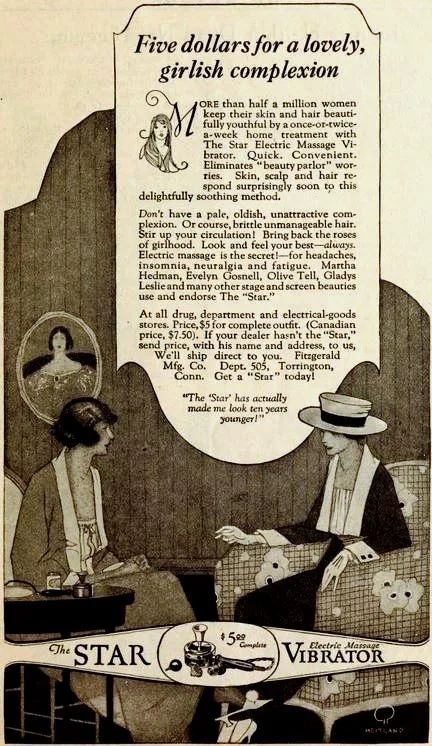
The copy aimed at whoever would buy a gadget. Fatigue, a sore back. Shirtless men show up in some of the later ads. Women in day clothes show up in others, holding the thing to a jawline. The American Medical Association soured on medical vibrators around 1915, calling them a fraud, which did not kill the consumer market. It just made the doctor’s-office channel less useful, so the ads leaned harder on the home.3
People were absolutely using some of these on genitals. You can tell from the copy that got a little sweaty, and from the fact that by the late 1920s the devices start turning up in stag films. You cannot tell, from a Sears line drawing of a woman mending a dress, what any one buyer did after dinner.
Then the ads thin out
Sometime around 1930, vibrators mostly leave the household magazines. Lieberman’s longer project — the dissertation behind her book Buzz — is about that turn: once the sexual use was harder to pretend away, mainstream display got riskier, and the “small appliance” disguise stopped being free advertising.4
The objects don’t disappear. The respectable catalog page does. You can still find beauty-and-relaxation positioning in the ’30s and ’40s, and you can find specialty shops and under-the-counter stock. What you don’t find is the 1908 version, where the New York Times will run the ad between the toasters.
This is also when bakelite and later plastics start replacing some of the metal-and-hard-rubber build. I just don’t have a famous bakelite model the way I have a Hamilton Beach. The named object is still the 1902 motor in a 1920s case.
April 1968
On April 25, 1968, Hitachi listed the Magic Wand for business in the United States. Twelve inches, 1.2 pounds, a rubberized head about two and a half inches across, AC power, no batteries, not waterproof, sold as a household electric massager.5 The USPTO filing is “electric massager.” Hitachi did not put “vibrator” on the box.
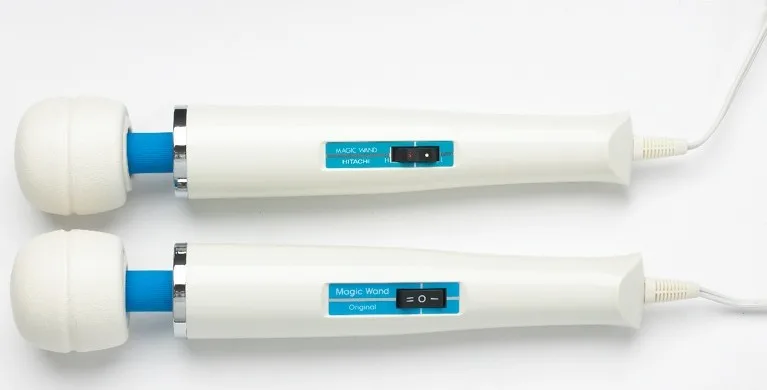
Photo: Vibratex, Inc., CC BY-SA 4.0. The later box drops the Hitachi name. Same motor.
That’s the last big appliance motor in this stretch. Betty Dodson is the person who walked it out of the small-appliance aisle and into a sex-ed workshop in the early ’70s. She bought hers at Macy’s.
The Wand’s motor is just a lot more powerful, and the shape is simpler, if you ignore the shoulder copy. The useful part, socially, is that you could buy it without going to a sex shop, which in 1970 mostly meant a shop that was not trying to sell to you.
Deluvery is a same-night adult wellness delivery service in DC. We carry toys, lubes, condoms, and personal care, and everything arrives in plain packaging with a forgettable name on the card statement. The 1918 Sears shopper had the page sitting on the kitchen table. The 1968 Macy’s shopper had a clerk.
Love, delivered in minutes.
Notes
-
Charles Lee Bryson, ed., Health and How To Get It (Hamilton-Beach Mfg. Co., 1912). Home-use manual for the New Life vibrator. ↩
-
Hallie Lieberman, “Selling Sex Toys: Marketing and the Meaning of Vibrators in Early Twentieth-Century America,” Enterprise & Society 17, no. 2 (2016). ↩
-
Martha Henriques, “The vibrator: from medical tool to revolutionary sex toy,” BBC Future, 2018. AMA characterization of medical vibrators; shift to consumer advertising. ↩
-
Hallie Lieberman, Taboo Technologies: Sex Toys in America Since 1850 (PhD diss., University of Wisconsin–Madison, 2014). Argues that after the 1970s, open sale as sexual devices pushed advertising out of mainstream publications that had carried “appliance” ads earlier. ↩
-
Hitachi listed the Magic Wand for U.S. business with the USPTO on April 25, 1968 (first use in commerce); trademark filed May 20, 1968 as an “electric massager.” Device specs commonly given as 12 in / 1.2 lb. See the Magic Wand history. Sex educator Betty Dodson popularized genital use in her early-1970s workshops. ↩
Subscribe for new posts
Get new blog posts in your inbox. This also includes occasional promos and marketing emails.