
October 4, 2026
Sex Toys, 1970–2000
A Macy’s clerk, then a rabbit with a battery pack
Dell Williams was in her fifties, an ad woman and a former Wac, when she took Betty Dodson’s Body/Sex workshop in New York and decided she needed a Hitachi Magic Wand. She went to Macy’s, because that’s where you bought a household massager. A young salesman asked her what she wanted it for. She went home and started a mail-order business at her kitchen table. In 1974 that became Eve’s Garden, usually described as the first woman-owned sex-toy shop in the United States.1
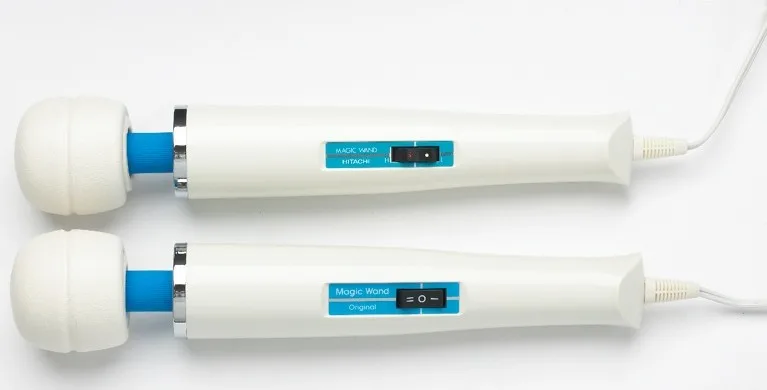
Photo: Vibratex, Inc., CC BY-SA 4.0.
The Wand itself is 1968, which is the end of 1920–1970. Williams got tired of buying it from a clerk who thought he was in on a joke.
A shop you could walk into
Joani Blank opened Good Vibrations in San Francisco in 1977. A clean shop with books on the shelf, and staff who would talk to you. Lynn Comella’s Vibrator Nation is the book on how Eve’s Garden and then Good Vibrations turned a product that had been sold in peep-show neighborhoods into something you could walk into without performing toughness. Babeland opens in 1993 and runs the same idea.2
DC’s version of that, much later and smaller, is the stretch between Dupont and Adams Morgan where Bite the Fruit and What’s Your Pleasure sit across the street from each other. Different inventory. Same idea: a person who knows the stock, and a door you can open in daylight.
The other channel in the ’70s was still the appliance aisle. Dodson’s early workshops used a Panasonic Panabrator. Panasonic discontinued it, she switched to the Wand around 1975, and that’s when she started telling people to get one at Macy’s.3 Hitachi kept calling it a massager. They finally took their name off the consumer packaging in 2013 and left the distribution to Vibratex, which tells you how long the open-secret phase lasted.
D cells
Most of the motors people actually took home were not a 12-inch AC brick. They ran on D cells, later AAs: a plastic cylinder, a cap that unscrewed, a thing you could put in a drawer without hunting for an outlet. Dodson was blunt about them. She would never use anything that required batteries, she told the Observer in 2000. Fine if the little one works for you. Not the same machine.3
The Wand is the famous object because it doesn’t quit, and because you could still buy it next to the hair dryers. The battery stick is the one that showed up in more nightstands. You could take it to a hotel.
The Turtle and the Hare
Vibratex, in Napa, started bringing Japanese dual-stim toys into the U.S. in 1983. The clitoral bit was an animal shape, not a realistic penis — a workaround for Japanese obscenity rules, and also just easier to sell. The Rabbit Pearl is 1984: a rotating shaft, beads in the middle, ears on the outside, battery pack in the base.4
On August 2, 1998, HBO ran Sex and the City’s “The Turtle and the Hare.” Charlotte buys a Rabbit. Carol Queen opened Good Vibrations the next day to a line of people asking for it by name. Vibratex didn’t even have HBO. A client mailed them a VHS. The company says average annual sales jumped more than 700% in the years after.5 The toy was already in shops. TV is why your aunt knows the word.
The cheap stuff
Once sex shops existed, factories in East Asia could fill them. Soft “jelly” PVC, porous, often with that chemical smell you notice when you open the package. Cyberskin, a Topco trademark, is a TPE-style blend sold as skinlike. It warms up. It also absorbs fluid and gets tacky as it ages.
Shops, by the mid-’90s, were telling customers to put a condom on the porous toys and treating non-porous materials as the ones you can boil.6 AIDS had already made people think harder about barriers. Hygiene was becoming something you asked about at the counter, not a pamphlet in the bag.
Phthalates — the plasticizers that make jelly toys jelly — were already restricted in children’s toys in the EU by the late ’90s. Adult products were usually labeled “novelties,” which is a legal shrug. Good Vibrations started warning people in the ’90s and moved to phase the stuff out. Babeland’s line at the time was more like: we tell you, you decide. The fight was not over when the decade ended. In 2007 NBC was still writing it as unresolved.6 The smell test is not a lab, but it’s the test a lot of people used.
A basement in Brooklyn
Silicone starts earlier than the shop-quality story. Gosnell Duncan was a paraplegic engineer. After a 1971 disability conference he started casting body-safe silicone in his basement, sold as Paramount Therapeutic Products: washable, custom-fit, not the rubber that melted and smelled.7
Marilyn Bishara was doing IT for Good Vibrations in 1992 when she got tired of how hard it was to get a toy that wouldn’t leach. She started casting platinum silicone in her kitchen. That company is Vixen Creations, still making small-batch, boilable, phthalate-free pieces, later out of Austin.8
Waterproofing in this period is mostly a marketing word. The original Wand is an AC brick with a cord. The battery rabbits are not going in the shower either. Fully washable, USB-chargeable bodies are the next era’s problem.
Deluvery is a same-night adult wellness delivery service in DC. We carry toys, lubes, condoms, and personal care, and everything arrives in plain packaging with a forgettable name on the card statement. Williams started with mail order because walking into the other kind of shop, in 1974, was its own publicity. A catalog goes to a name. A brown box on a porch is later.
By the late ’90s you’ve got jelly with a novelty disclaimer on one side, and silicone you can boil on the other. USB and a vibrator on a Walmart shelf is next.
Love, delivered in minutes.
Notes
-
Robert D. McFadden, “Dell Williams, Founder of Sex Boutique, Dies at 92,” New York Times, March 14, 2015. Eve’s Garden, 1974; Macy’s Magic Wand episode after a Betty Dodson workshop. Cornell holds the Dell Williams papers. ↩
-
Bourree Lam, “The Women Who Made the Market for Vibrators,” The Atlantic, 2017. Interview with Lynn Comella on Vibrator Nation; Eve’s Garden (1974), Good Vibrations (1977), Babeland (1993). ↩
-
Andrew Goldman, “Panic in Bedrooms as Magic Wand, Cadillac of Vibrators, Disappears,” Observer, June 19, 2000. Dodson’s switch from the Panasonic Panabrator after it was discontinued; she would not use a battery vibrator (“no comparison”). ↩ ↩2
-
Vibratex, “Crafting Pleasure Since 1983.” Founded 1983 by Harold and Suzi Spielberg; Rabbit Pearl launched 1984. Shay Martin, interviewed in Cosmopolitan, on importing Japanese dual-stim toys in 1983 and animal shapes as a workaround for Japanese obscenity rules. ↩
-
Lynn Comella, “20 Years Later, How The ‘Sex and the City’ Vibrator Episode Created A Lasting Buzz,” Forbes, August 7, 2018. “The Turtle and the Hare,” 1998; Carol Queen on the Good Vibrations line the next day; Vibratex learning from a VHS in the mail; company figure of more than 700% in average annual sales afterward. ↩
-
“When sex toys turn green — for health, that is,” NBC News, 2007. Phthalates in jelly PVC; Good Vibrations’ condom-over-porous-toys advice since 1994 and plans to phase phthalates out; Babeland’s then-position. See also Grist on the “novelty” labeling dodge. ↩ ↩2
-
Hallie Lieberman, Buzz: The Stimulating History of the Sex Toy (Pegasus, 2017). Duncan as the paraplegic engineer who made silicone dildos. The 1971 disability conference, basement workshop, and Paramount Therapeutic Products are summarized from Buzz in Mikelle Street, “The 1000 Year History of The Strap-On,” Them. ↩
-
Vixen Creations, “Our History.” Marilyn Bishara, 1992, Good Vibrations IT, kitchen casting; platinum silicone. ↩
Subscribe for new posts
Get new blog posts in your inbox. This also includes occasional promos and marketing emails.